
How to Make a Family Tree: Step by Step, With a Template You Can Draw
How to make a family tree on paper, in a spreadsheet or in an app — a four-generation template you can draw in minutes, the numbering genealogists use, and every relationship word from second cousin to once removed.
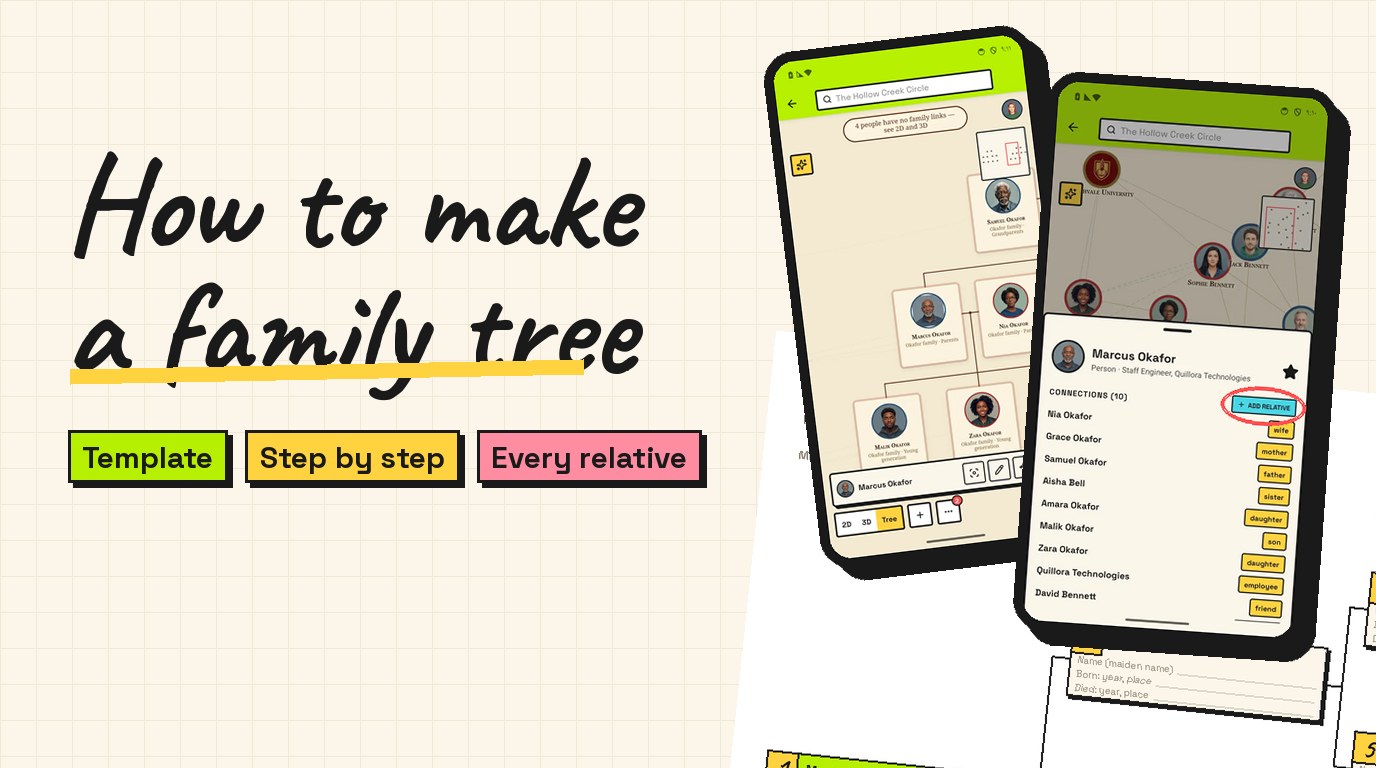
Making a family tree looks like an afternoon's work until you start. Then the questions arrive: what was Grandma's name before she married? Where does a stepfather go? And what, exactly, is a first cousin once removed? This guide answers those questions in the order you will hit them. You do not need any software — paper and a pencil are enough — and at the end there is an honest look at when an app saves you work and when it does not.
First decide: where you come from, or who belongs?
There are two ways to draw a family, and it pays to choose before the first line. A pedigree chart starts from one person and goes up: two parents, four grandparents, eight great-grandparents. It doubles every generation and has no room for siblings. A descendant chart does the opposite: it starts from one couple and runs down through their children, grandchildren and great-grandchildren.
For a school project or a birthday present, the mix is almost always right: you in the middle, parents and grandparents above, brothers, sisters and cousins beside you, children or nieces and nephews below. That is how the example further down is built.
A family tree template you can draw in five minutes
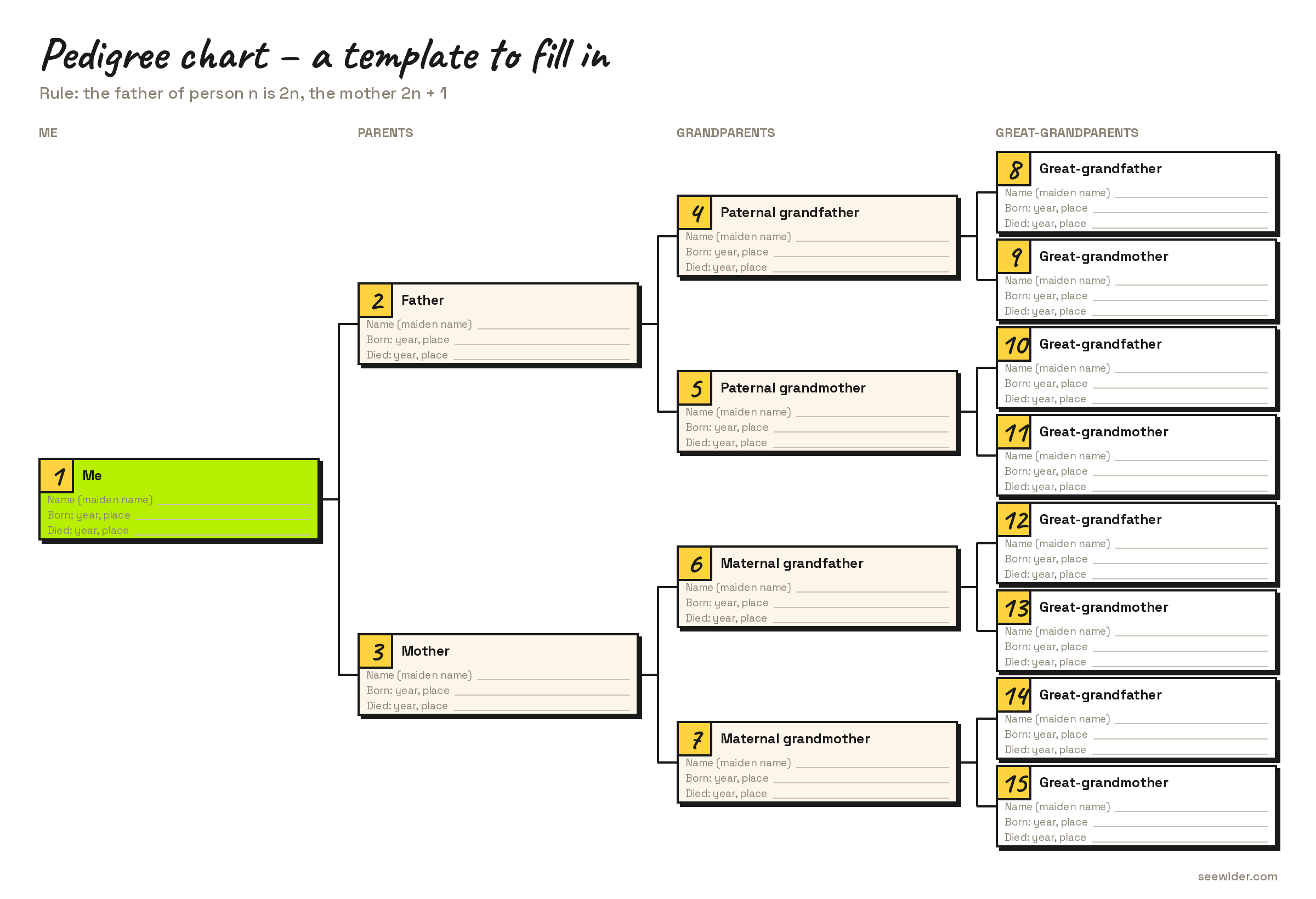
Genealogists number ancestors with one rule, called ahnentafel or Sosa-Stradonitz numbering: you are 1. The father of person n is 2n, and the mother is 2n + 1. Your father is 2 and your mother 3; your father's parents are 4 and 5, your mother's are 6 and 7; your great-grandparents run from 8 to 15.
That one rule is the whole template. The number tells you where each person goes without drawing anything, so you can collect names on index cards or in a list and lay them out later. Men are always even and women odd (except number 1), and a gap is only a gap: if you do not know who number 13 was, number 12 stays exactly where it is.
How to make a family tree, step by step
One: start with yourself, not with the oldest ancestor. Work upward from what you know for certain. Starting from the great-grandfather in a family story means building on sand.
Two: ask the living while you can. The best source is at the next family dinner. Ask for full names, years and places, and ask for photographs — the back of an old picture often says more than any archive. Write down who told you what.
Three: look for papers at home. Birth and marriage certificates, funeral cards, family Bibles, old letters, an obituary clipped from a newspaper. These alone often take you back two generations.
Four: then go to the records. Birth, marriage and death records are kept by the state or county in the US and by the General Register Office in England and Wales. Census returns are opened to the public after 72 years in the US and 100 in the UK, and they list whole households, which makes them the fastest way to find brothers and sisters nobody mentioned. FamilySearch has a vast collection of these records online, free.
Three questions everybody gets stuck on
Maiden names. Record every woman under the surname she was born with, and add her married name after it — traditionally with née: Laura Hartley, née Bennett. A tree that only keeps married names loses a whole family line with every wedding, because a mother's family can only be traced through the name she was born with.
Step-parents, half-siblings and adoption. A family tree shows descent; a family shows who belongs together, and the two are not always the same. Draw both, but make them look different: a solid line to birth parents, a dashed one to a step-parent, a mark of its own for adoption. Half-siblings share one parent, step-siblings none — drawing them the same makes the tree wrong, not kinder.
Someone appears twice. When two distant relatives marry, the same ancestor shows up in two places on your chart. Genealogists call it pedigree collapse, and it is far more common than people think — almost the rule in small towns. On paper, a note ("see no. 12") is enough; never draw the same person twice with different details.
An example: the Bennetts and the Okafors
Here is what all of that looks like together. The Bennetts and the Okafors of Hollow Creek are an invented example family — three generations, two families, linked by friendships, workplaces and a university. Sophie Bennett is in the middle. Above her are her parents, David and Emily, and above them her grandparents, Robert and Margaret. Her aunt Laura was born a Bennett and became a Hartley when she married; Laura's children, Chloe and Ethan, are Sophie's first cousins. Tap anyone to see their parents, partner and children.
Sophie and Chloe: first cousins through the Bennett grandparents

Sophie
Design student, Northvale University

Chloe
From Robert Bennett to his granddaughter Sophie
 Robert
 DavidSophie
Every relationship word you will need
Upward: parents, grandparents, great-grandparents, then great-great-grandparents — one more great for every generation. Downward the same way: children, grandchildren, great-grandchildren. Where the side matters, say paternal or maternal: your maternal grandmother is your mother's mother.
Sideways: your parents' brothers and sisters are your uncles and aunts, and their children are your first cousins. Your brothers' and sisters' children are your nephews and nieces. Your grandparents' siblings are your great-aunts and great-uncles (also grand-aunt and grand-uncle — both are correct), and their grandchildren are your second cousins: you share great-grandparents, not grandparents.
Removed is the word everybody gets wrong. It counts the generations between two cousins. Your first cousin's child is your first cousin once removed — one generation down. Your parent's first cousin is also your first cousin once removed — one generation up. Your first cousin's grandchild is your first cousin twice removed. A second cousin is never "a first cousin once removed"; it is a different degree, not a different generation.
By marriage: your partner's parents are your in-laws — mother-in-law and father-in-law — and you are their son-in-law or daughter-in-law. Your partner's brothers and sisters and your siblings' spouses are all your brothers-in-law and sisters-in-law. Outside blood but inside the tree: stepfather, stepmother, stepchild, step-sibling, and, with one parent in common, half-brother and half-sister.
Paper, spreadsheet or family tree maker: an honest comparison
Paper is unbeatable for a first draft, for children and for anything meant to hang on a wall. It gets hard the moment something changes: a new baby, a forgotten aunt, and the neat sheet fills up with arrows. A spreadsheet — one row per person, columns for the ahnentafel number, names, maiden name, dates and places — is the best tool there is for collecting. It sorts, it shares, and it will still open in twenty years. It just does not draw.
Software pays off once the tree grows or several people work on it. For serious research with sources and archives, FamilySearch, Ancestry, MyHeritage and desktop programs that read GEDCOM files are the right tools, with access to digitised records. If what you want is to see your own family — with faces, on your phone, with cousins adding their own branches — that is what we built SeeWider for.
How to do it in SeeWider
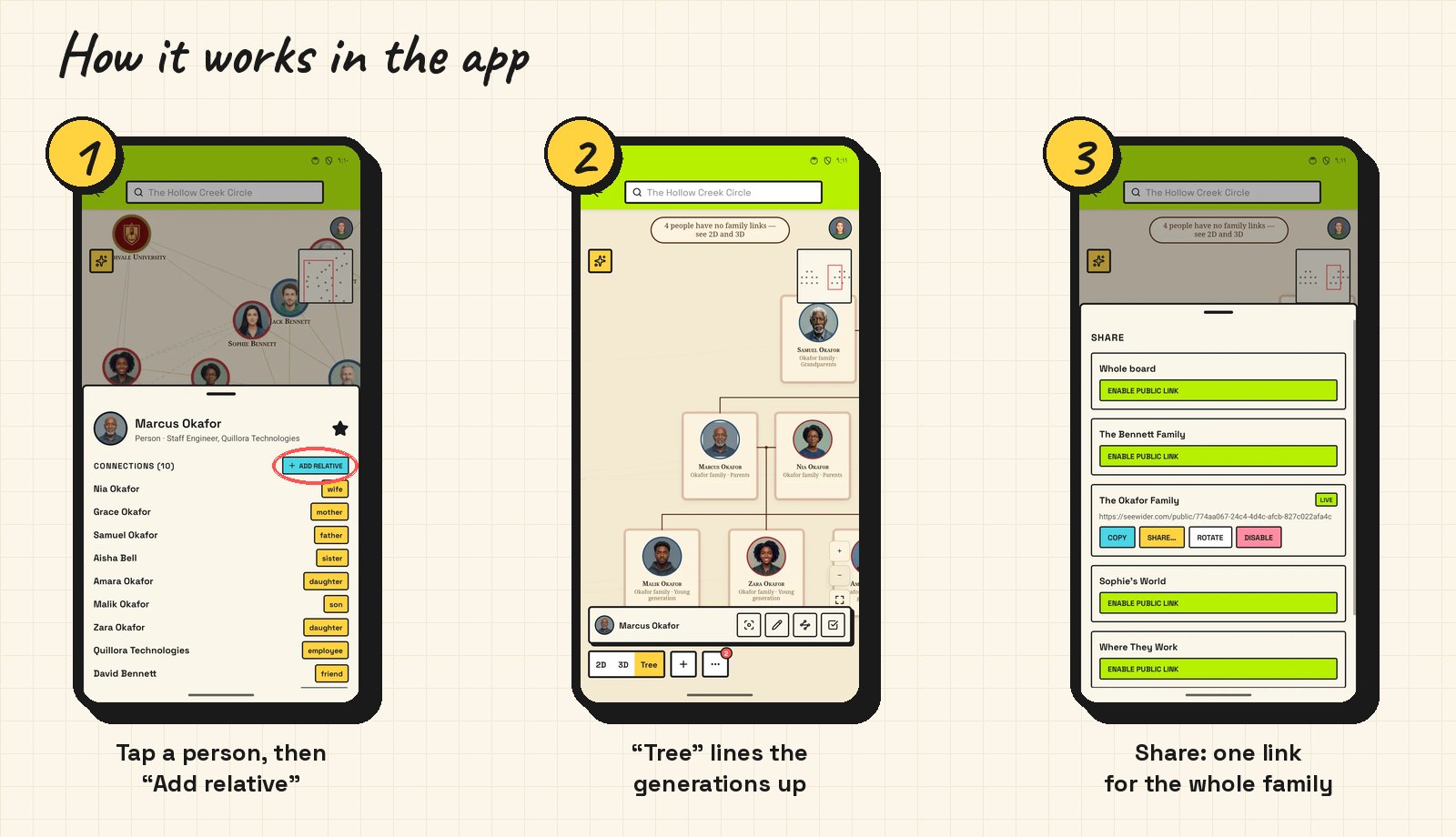
One: create a new board and add yourself. If you would rather look around first, New from template has this same Bennett family to try things on. Two: tap yourself and choose Add a relative — parents, partner, children, siblings. If you add brothers or sisters without knowing one of their parents, the board leaves a blank card instead of inventing somebody. Three: add photos and birth years; with faces on it, a family recognises itself at once. Four: invite relatives from Members & invites so each of them fills in their own branch, or share it as a picture.
SeeWider is on Google Play for Android and also works in the browser. And if you would rather stay with paper, the numbering above works with any pencil.
Common questions
- How do I make a family tree?
- Start with yourself, add your parents and grandparents, ask older relatives for names, dates and places, then fill the gaps from certificates, census returns and vital records.
- How do I make a family tree for a school project?
- Put the student in the middle, parents and grandparents above, brothers, sisters and cousins beside them. Three or four generations with names, birth years and a photo of each person is plenty.
- Is there a family tree template I can draw myself?
- Yes: one box for you, two for your parents, four for your grandparents and eight for your great-grandparents, each numbered so the father of n is 2n and the mother 2n + 1.
- What information goes on a family tree?
- Each person's full name, maiden name for women who married, year and place of birth, and year of death. Marriage dates are a useful extra if there is room.
- What is ahnentafel numbering?
- A way to number ancestors: you are 1, the father of person n is 2n and the mother is 2n + 1. Your parents are 2 and 3 and your grandparents 4 to 7.
- What is a first cousin once removed?
- Your first cousin's child, or your parent's first cousin. "Removed" counts the generations between you, so it is one generation away from being your first cousin.
- What is the difference between a second cousin and a first cousin once removed?
- Second cousins share great-grandparents and belong to the same generation. A first cousin once removed shares your grandparents or great-grandparents but sits one generation above or below you.
- How do I show step-parents and half-siblings on a family tree?
- Draw birth parents with a solid line and step-parents with a dashed one. Half-siblings hang only from the parent they share; step-siblings share no parent at all.
- Where can I find records of my ancestors for free?
- FamilySearch has a large free collection of birth, marriage, death and census records. Census returns are released after 72 years in the US and after 100 years in the UK.
- What is the best family tree maker app?
- For archive research, FamilySearch, Ancestry or MyHeritage. To draw your own family with photos on your phone and fill it in together, SeeWider is on Android and in the browser.