Who's who in The Three Musketeers: twenty-four characters, one chart
Twenty-four characters from Dumas' novel on a single chart — the four friends and their four servants, the twelve diamond studs to be fetched from London, and the woman branded on the shoulder.
Canon: The 1844 novel

In The Three Musketeers hardly anybody is related to anybody. A father left behind in Béarn, a haberdasher and his wife, a queen and the husband she does not love — and one marriage the novel hides for six hundred pages. Everything else, which is to say the whole book, is held together by chosen ties: four friendships, four servants, a captain, a cardinal. That is what this chart draws, because that is where the story is.
The chart at a glance
How to read it
Every card is a character and every line a relationship you can click. The coloured bands separate the camps: the king's musketeers, the servants, the French court, the cardinal's party, England. Where there is no kinship, the line says what it is: poisoner of, seducer of, wounded in a duel by, signs the commission of.
Four friends, and four servants who double them
d'Artagnan arrives in Paris on a yellow horse with fifteen crowns and a letter of introduction that is stolen from him on the first day. He picks three fights before noon and thereby makes three friends: Athos, the greatest lord of the four and the most silent about himself; Porthos, whose baldric is embroidered with gold only at the front, because the back of it is plain buff; Aramis, a musketeer "for one year only" these four years. Look at the chart: each master has exactly one servant, and each resembles his. Planchet the Picard, hired for the look of him. Grimaud, whom Athos has forbidden to speak and who answers in signs. Mousqueton, dressed in his master's cast-off splendour. Bazin, who has been waiting years for the cassock and files away the letters from women with a sigh.
The four, and the four

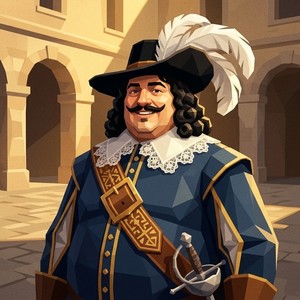





All for one, one for all.
The affair of the studs: four days to get to London
Anne of Austria has given an Englishman twelve diamond studs that the king gave her. Richelieu, who once loved her and now watches her, has Louis XIII advised to ask her to wear them at a ball. The queen is lost — and it is Constance Bonacieux, her seamstress, married to a haberdasher forty years her senior, who sets in motion the only man available: the one who is in love with her. On the chart the chain is short and it runs entirely through people with no power: a queen, her seamstress, a Gascon cadet and a Picard servant. Facing them stand a minister, his guards and his spy.
From the queen to the duke, and who you have to go through
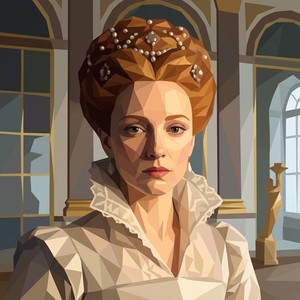 Anne d'Autriche
 Le duc de Buckingham
The court, and England


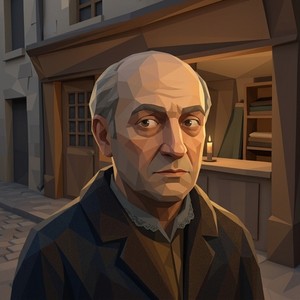
Milady, and the shoulder nobody was meant to see
Blonde, twenty-five, a face like an angel and a fleur-de-lis under her left shoulder. She has been a countess, she is twice a widow, and she works for the cardinal — who does not even need to brief her in detail. She poisons Constance, orders Buckingham's murder, and comes within an inch of d'Artagnan twice. Her weapon is not the sword: it is people. Kitty, her maid, opens her own mistress's bedroom out of love for d'Artagnan. John Felton, a Puritan officer, sober and incorruptible, listens for four days while she recites his own psalms back to him through a door, and then goes and kills his minister. The chart puts those two lines side by side: seduced by and assassin of.
The cardinal's agent

Milady de Winter
L'agent du cardinal
Blonde, vingt-cinq ans, un visage d'ange et une fleur de lys sous l'épaule gauche. Elle a été comtesse, elle est veuve deux fois, et tout ce qu'elle touche meurt.
Married Athos
Athos's secret, which is the most important line on the chart
The count and the countess
Athos
Le comte de La Fère
Milady de Winter
L'agent du cardinal
Around Milady
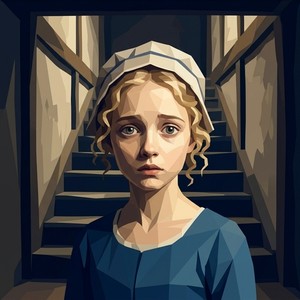



The cardinal loses every round and wins the match
The studs come back in time, Milady is tried and executed, Buckingham is dead, the siege of La Rochelle is won. And on the last page the man who lost everything in this story signs d'Artagnan's lieutenant's commission and takes him into his service. That is why Rochefort, the man of Meung who steals the letter on page one, keeps turning up in front of d'Artagnan at every stage of the book and ends by shaking his hand: the novel does not finish with a victory over the cardinal. It finishes with a job.
The two antechambers
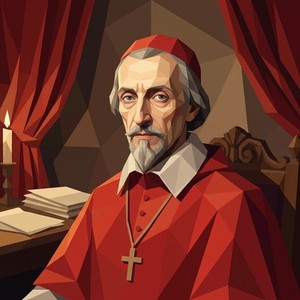

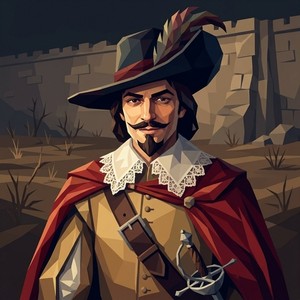
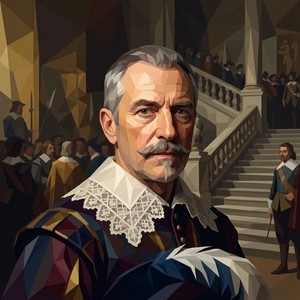
Tréville, and the one piece of advice d'Artagnan takes
Monsieur de Tréville is a Gascon who came up to Paris like the rest of them and became the man the king listens to and the cardinal handles carefully; his antechamber is the one place in Paris where anything may be said. Monsieur d'Artagnan the elder left his son nothing but a horse, fifteen crowns and three pieces of advice: fight often, put up with nothing from anyone, and count on Tréville. It is the third one that works. And Madame Coquenard, the attorney's wife who is in love with Porthos, provides a Lenten dinner and an outfit: in this novel the money always comes from somebody nobody talks about.
On the last page
Still standing
 d'Artagnan
- Athos
- Porthos
- Aramis
- M. de Tréville
- Le cardinal de Richelieu
- Le comte de Rochefort
- Planchet
- Grimaud
- Mousqueton
- Bazin
- Anne d'Autriche
- Louis XIII
- Lord de Winter
- Ketty
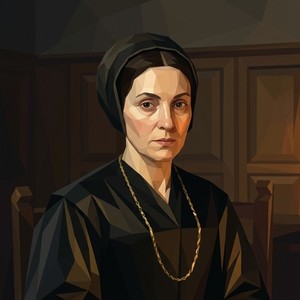 Mme Coquenard
Gone
- Constance Bonacieux
- Milady de Winter
- Le duc de Buckingham
The novel and the history
In the novel
Four inseparable friends, a spy branded with a hot iron, twelve studs saved in four days, and a night trial on the bank of the Lys. This whole chart is that one: the ties Dumas wrote.
In the history
D'Artagnan existed — Charles de Batz de Castelmore, killed at the siege of Maastricht — and so did Tréville, along with Anne of Austria, Louis XIII, Richelieu and Buckingham, assassinated in 1628 by an officer named Felton. Milady is an invention, and the affair of the studs a memoirist's anecdote that Dumas turned into a race. The chart claims nothing more than to draw the novel.
Who is not on the chart
Not the guards by name, not the innkeeper at Meung, not the dozens of extras from the duels and the sieges, and nobody from the two sequels — Twenty Years After and The Vicomte of Bragelonne — in which several of these cards would have children. Twenty-four characters, chosen because the book keeps returning to them: the four, the servants, the court, the cardinal, Milady and what surrounds her.
Common questions
- Who wrote The Three Musketeers?
- Alexandre Dumas, with Auguste Maquet, in 1844.
- Who are the three musketeers?
- Athos, Porthos and Aramis — and d'Artagnan, who is not one of them at the start.
- Is Athos a nobleman?
- Yes: the Comte de La Fère, and Milady's former husband.
- How are Milady and Athos connected?
- They were married. He had her hanged, as he believed, before the novel begins.
- Who is Mordaunt?
- Milady's son, who comes back for revenge in Twenty Years After.
- Whose son is Raoul?
- Athos's, raised by him under the name Vicomte de Bragelonne.
- Did these people really exist?
- D'Artagnan and the musketeers have real models; the plots are Dumas's.
- Who is Constance Bonacieux?
- The queen's seamstress and d'Artagnan's love, poisoned by Milady.
- What is Richelieu's part in it?
- The cardinal, political adversary of the musketeers and Milady's employer.
- How many sequels are there?
- Two: Twenty Years After and The Vicomte of Bragelonne.